Breitling Navitimer Replica Watches
Independent buyer-focused reference • Updated September 7, 2026
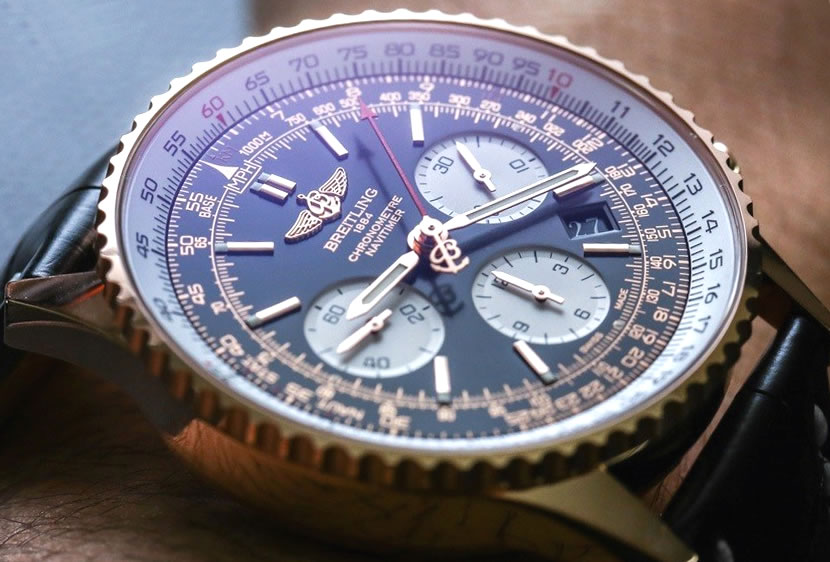
Breitling Navitimer replica watches: what matters before you compare one
The Navitimer is unusually difficult to reproduce convincingly because its identity is built around many small relationships rather than one obvious design feature. The slide-rule scale, the outer chapter ring, the three chronograph registers, the date position, the hands and the dense dial typography all have to align. A watch can look impressive in a distant photograph and still appear wrong as soon as the dial is viewed straight on. For that reason, a serious Breitling Navitimer replica comparison should begin with proportions and printing, not with a seller's grade name.
This guide focuses on the questions that matter to a buyer comparing Navitimer-style replicas in 2026: which model family the watch is trying to reproduce, whether the case and dial belong together, whether the movement architecture matches the displayed subdial layout, how to judge slide-rule alignment, and which marketing claims deserve extra verification. It also preserves the historical context that made the Navitimer distinctive in the first place, because knowing the purpose of the original design makes inaccurate copies much easier to spot.
Why the Navitimer is harder to copy than a simple three-hand watch
A simple watch may be judged mostly by case shape, dial color and bracelet finishing. The Navitimer adds several layers of geometry. The circular slide rule is not decoration: its printed scales have to sit concentrically around the dial and line up with the rotating bezel or flange. Small errors in spacing become obvious because the dial is already dense. Chronograph subdials create another challenge. If a replica uses a movement whose register positions do not naturally match the reference, manufacturers may alter the dial layout or use extra gearing, which can change thickness, hand height and reliability.
Case thickness matters for the same reason. A movement that requires additional modules can force the case taller than the reference. The crown and pushers can then appear too low or too high relative to the case band. On a polished bezel, inconsistent finishing is also easy to see. A convincing example therefore needs coherent engineering across the dial, movement and case rather than a collection of individually attractive parts.
Navitimer 01, GMT, World and Cosmonaute: do not treat them as the same watch
“Navitimer replica” is a broad search term, but Navitimer references are not interchangeable. The Navitimer 01/B01 family is usually recognized by its classic three-register chronograph arrangement and aviation slide rule. Larger World and GMT variants introduce different proportions and additional time-zone information. Cosmonaute models use a 24-hour concept that changes how the hour indication is read. A listing that mixes photographs or specifications from several families is a warning sign because case diameter, dial architecture, date location and movement behavior may not match.
Before comparing price, identify the exact design the listing claims to reproduce. Save a straight-on dial image and a side profile. Then compare the placement of the registers, date aperture, logo, bezel markers, crown, pushers and case-back style as a group. This is more reliable than judging one logo or one engraving in isolation.
A practical Navitimer replica quality checklist
1. Dial printing and scale alignment
Look for crisp numerals, even spacing and concentric printing. On a slide-rule watch, tiny misalignment around the perimeter is more noticeable than on an uncluttered dial. Ask for a high-resolution photograph taken straight on; angled promotional images can hide alignment problems.
2. Chronograph register position and operation
Do not assume every subdial is functional merely because it has a hand. Ask what each register measures and request a short video showing start, stop and reset. The central chronograph seconds hand should reset cleanly, and the subdial functions should correspond to the advertised movement rather than to decorative hands.
3. Case thickness and pusher geometry
Compare the side profile. Excess thickness can indicate a movement architecture that differs substantially from the intended reference. Check whether the crown and pushers sit naturally in the case band and whether the bezel overhang looks proportionate.
4. Bracelet, clasp and end-link fit
Gaps between the first link and the case, sharp edges, loose clasp tolerances and inconsistent brushing are common places where quality differences show. These details are often more useful than broad grade labels.
5. Movement claim
Terms such as “Swiss,” “ETA,” “Asian 7750,” “B01 clone,” “1:1” and “super clone” are used inconsistently in the replica market. A buyer should ask for the actual movement designation, a movement photograph where possible, beat rate, chronograph functions and service expectations. A marketing label by itself is not evidence.
Understanding the slide rule instead of treating it as decoration
The Navitimer became associated with aviation because its circular slide rule could assist with calculations such as multiplication, division, speed, distance and fuel-related conversions. Modern buyers may never use those functions, but the scale remains the visual signature of the watch. On a replica, the useful test is not whether every historical calculation will be performed in daily life; it is whether the rotating scale moves correctly, whether printing remains legible and whether corresponding marks can be aligned without obvious drift.
A decorative ring that only resembles a slide rule can look acceptable in small photographs yet fail immediately under close inspection. If functional fidelity matters, ask the seller to demonstrate rotation and alignment rather than relying on the phrase “fully functional.”
Movement choices and why “B01 clone” needs careful interpretation
Breitling's in-house B01 architecture is part of the identity of many modern Navitimer references, but replica listings frequently use “B01” as a visual or marketing description rather than a precise statement of mechanical construction. Some watches use a chronograph movement with a broadly similar dial arrangement; others use altered or decorated movements intended to resemble a particular bridge layout. Those approaches can differ substantially in thickness, serviceability and parts availability.
For practical ownership, movement reliability and service access matter more than a decorative rotor. Ask whether a competent independent watchmaker can service the caliber, whether replacement parts are obtainable, and whether the chronograph can be operated regularly without unusual restrictions. If the seller cannot identify the movement beyond a grade label, treat the claim conservatively.
What a buyer should verify before paying
Request current photographs of the exact version being sold, not only factory catalogue images. Confirm case size, dial color, bracelet or strap, movement type, chronograph functions and what level of water resistance—if any—has actually been tested. Replica watches should not be assumed to meet the depth ratings printed on a dial or case back. Pressure testing is the only meaningful evidence of water resistance.
Also read the seller's return, exchange and delivery terms. A technically convincing watch is still a poor purchase if the merchant provides no clear remedy for a damaged shipment or a watch that differs materially from the listing. Payment protection and traceable shipping can matter as much as cosmetic accuracy.
Navitimer history in context
The Navitimer emerged in the early 1950s as a chronograph built around a circular slide rule for aviation calculations. That functional identity is why the watch has remained recognizable through decades of changes in case size, movement and dial execution. The Cosmonaute later adapted the concept to a 24-hour display associated with astronaut Scott Carpenter's orbital flight in 1962. The important point for a modern comparison is not to turn this history into decorative copy; it is to understand that the Navitimer's design follows an instrument logic. When a replica gets that logic wrong—misaligned scales, incorrect register relationships or mismatched proportions—the errors stand out quickly.
Frequently asked questions
What is the most important detail on a Breitling Navitimer replica?
There is no single detail. The strongest indicator is coherence: dial scale alignment, register placement, case thickness, crown and pusher geometry, bracelet fit and movement functions should all correspond to the same reference.
Does “1:1” prove a replica is accurate?
No. “1:1” is a marketing term, not a recognized manufacturing standard. Compare measurable specifications and current photographs instead.
Should a Navitimer replica be considered water resistant?
Do not rely on printed depth ratings. Treat water resistance as unverified unless the individual watch has passed a pressure test.
Is a so-called B01 clone the same as a genuine Breitling B01?
No. The term may describe appearance, layout or a replica-specific caliber. Ask for the exact movement and service information.
Why can two Navitimer replicas with similar photos have very different prices?
Differences may come from movement type, case and bracelet finishing, dial printing, crystal treatment, quality control, seller warranty and after-sales support. Price alone does not prove quality.
Transparency and trademark notice
NavitimerReplica.top is an independent informational site and is not affiliated with, endorsed by, or an authorized retailer of Breitling. Breitling, Navitimer and related model names are trademarks of their respective owners. Replica watches are non-genuine products. Readers should verify local laws, customs rules, seller terms, materials and movement claims before making a purchase decision.